Episode Transcript
[00:00:00] Speaker A: First of all, I want to express my condolences in relation to the hardship and painful events these previous weeks in Turkey. In my hometown, Kent, and even in my street, there is a large Turkish community that that is also with their mind and their hearts with you and sends you all the support they can.
I hope the coming half an hour to share and offer some ideas and a kind of compass to navigate together with children, youngsters and their families in such a times of traumatic experiences, loss and grief.
I also want to apologize for my English as I'm not a native speaker and I will share with you the stories of Victor, a young boy of 11 years old whose life was pretty good until that what he self called the disastrous exploding Sunday.
It is not a Turkish story, but I hope that his story can connect with the many stories of children and youngsters after the earthquake in Turkey.
I'll take you to the PowerPoint where you will see and meet some pictures that Victor made, some things that we together tried to put into language.
The story of Victor starts with that he was living with his mom and his dad and his little sister of five years old.
And his grandparents were living in the neighborhood. And his best friend and schoolmate was only five minutes away on his bike.
On a Sunday, all together they were driving back from a trip to the seaside.
Suddenly a car was popping up, racing with another car and driving on the wrong side of the road.
He hears his mom, Riel, and the next second an enormous crash, an explosion, and everything becomes dark.
Three days later he gets awake in a hospital bed 100km from home, his both legs broken. There was an operation of nine hours.
His both parents were dead.
His little sister is okay and stays with his grandparents.
He needs to stay for months in the hospital.
These first days and weeks, Victor speaks very little. He only nods with his head yes or no.
Very easily and very quickly. Panic attacks pop up at such a moment. He yells, screams, wants to break free from the drip and get out of the bed. Or suddenly he bangs his head against the bedside until it bleeds.
He often stares at the television, although it seems he isn't really watching and listening.
Everyone is very worried. The nurses and doctors no longer know what to do.
Grandmother is most of the time in tears.
She tries to take care of his little sister. And grandfather doesn't know what to say. He looks like a broken man.
As children walk through the landscapes of their life, they never walk alone.
They are an association of life, a web of relationships and in a multiplicity of contexts in the course of their life, obstacles, constraints, pitfalls. Swirling rivers can pop up painful, shocking events, traumatic experiences can make them tumble in a swirling river.
And they have to try to keep themselves from drowning, keep their head above the water in some ways, and how to prevent that everything becomes dark and how not losing sight on what and who matters, but very easily they lose sight on what and who matters. And they are not only tumbling alone in that swirling liver. No, many times the people involved, the people who are very significant in their lives and also the professionals tumble into these swirling rivers.
A cluster of problems and problem narratives got nestled. It got nestled in their bodies, in their thoughts, in their relationships and social context, and even leading furthermore to problematic actions and overwhelming emotions.
Often there is a surge going on by the child and many involved about how to stay afloat, how to make sense of all this, what are still livable tracks.
And even more, how can they interpret these difficulties and problems, these traumatic events?
And how will they start to interpret themselves, their family and their relatives?
And before you know it, it can all become very single stories, reduced and negative stories about the difficulties and about themselves.
They also risk to get trapped in unhelpful relational dances with each other.
They try to stay above the water altogether in some ways.
Yeah, an important problem in all this is that we can't understand from the outside and from the outset what will be experienced as traumatic and what kinds of meaning and stories will be created.
It can't be understood, disconnected from all the relationships and context these children and families live in.
So what the most painful, traumatic thing will be for Victor, we can't understand from the outside. Will it be the car crash, the loss of his parents, the staying in the hospital, the surgeries?
And what will be felt and experienced as the most painful in those traumatic experiences can be very different from what his little sister experienced and feels as traumatic. What the grandparents hurts the most.
So what meanings will be created by all those different people can be very different.
But what we can notice very easily in these context contexts, when children, youngsters and their beloved ones tumbled in that swirling river, Rapidly expanding all slick across relationships and life domains, Many of the children, as well as their families, relatives, carers, experience an overriding feeling of powerlessness, helplessness and hopelessness.
They have often the feeling of being lost, no longer having a sense of grip, influence on their bodies, actions, emotions, even no longer a sense of mattering.
So they no longer experience a sense of agency.
Often they also no longer experience a sense of belonging. They are often trapped in a sense of isolation.
Alienation and loneliness.
And at the same time, they often have the feeling that they have become very fragmented.
Yeah, there becomes a kind of split between before and after the ill events. And the question, who am I?
The response gets lost. So they no longer experience a sense of continuity and coherence.
They no longer experience themselves as active participants in their lives, relationships and the meaning making processes.
This means that we have to reflect very carefully how to respond in a supportive and helpful way so they can rediscover a sense of agency, belonging and coherence in other ways. How can we bring them to a riverbank position and so they can refine some breathing space, a zone of calmness and safety.
So when we start to meet for the first time, these children, young people, sometimes their parents, their families, they lost the ground beneath their feet. And their ideas, beliefs about the world, relationships themselves are fundamentally shaken.
So that means when we meet them somewhere in a hospital room, in a conversation room, in their own homes, uncertainty, suspicion, mistrust, fear and so on have often nestled in their bodies and accompany our meetings.
Just like the many voices and social discourses about how to respond, act, recover, process, heal, join us.
And that brings me to some questions, some very important questions that we have to ask ourselves before we really start to meet and start our journey together with children and youngsters.
How can we in our work together not reproduce experiences of trauma, nor subscribing or further solidifying single stories or meaning?
How can we respond in helpful, supportive and cultural appropriate ways and not tumbling into unhelpful relational dances?
How to create contexts of recognition, acknowledgment for the suffering loss, but also for their responses, relational efforts, skills and knowledge.
So as everybody is very worried about Fictor, no one experiences any longer any sense of agency because he doesn't want to see no one. And when people enter the hospital room, he starts to yell, scream, go away. No, no, no. And he boycotts the medical interventions. The panic attacks increase in all kinds of ways.
I have to send out a well considered invitation for connection.
I have to reflect very well. How can we link together and how can we start together a kind of journey that we can step out that swirling river and find a riverbank position.
And I created a menu that was a kind of invitation that looked for connection. Yeah.
And one of the nurses brought that menu list looking for connections. And some questions on that menu list were, what is one of your favorite dishes?
What is one of your favorite television shows, Netflix series or movies? What is your favorite piece of clothing?
What is your Favorite animal and so on and so on. I had a list that he just could fill in.
And after the nurse had brought that menu looking for connection, a few hours later, he returned the menu looking for connection with some responses like I discovered that his favorite football player was Kevin de Bruyne. Maybe somebody knew of. You knew Kevin de Bruyne, but he's very famous over here in Belgium.
I discovered also that one of his favorite games was Minecraft and that he created a whole world in Minecraft.
And also very interesting was that he had a whole collection together with his father about Pokemon cards. Yeah.
And in relation to his mother, I also discovered that he loved really the baking, the cooking of his mom. And her most delicious thing that she prepared in the kitchen was banana cake.
Yeah.
That menu list, looking for connection was an opening and an invitation towards him to become an active participant, to become a co researcher and co director.
I wanted to have as an antidote for the experience, being a passive receiver of trauma.
And as research already showed a lot, that the quality of our alliance with children and youngsters or ways of collaborating is the best predictor for good outcome.
So if I have sent an invitation and he responds to that invitation, then maybe we can start our journey for recovery refining safe grounds and doing safety together.
Yeah.
In that sense, yeah. I want from the very start, hem to become an active participant, find safe ground doing safety, but also creating together with him a team of mutual support and solidarity so that we, from the very start also can foster experiences of a sense of agency, belonging and coherence.
And all this links with resilience and resilience processes and resilience, research and resilience, not as an individual, but as an emergent process in a complex web of reciprocal influences and stories.
Yeah.
What I want to do is weaving together networks of resilience as relationships are the most powerful buffers and antidote to the tricky, painful effects of traumatic experiences. I want to search together with him and his family, his grandparents, maybe his little sister, his friends, the doctors, the professionals, for shared language opportunities to make him share experiences, share stories and co create new perspectives and meanings that enable new actions or tracks so that we really can rediscover a sense of agency, mattering, belonging and coherence.
Yeah. So in trying to weave together networks of resilience, I'm looking for safe ground and doing safety.
Yeah.
And that means that I'm not going to talk about safety, but I have to reflect very carefully. How can we do together safety and rediscover their knowledge about Safety and comfort, comforting themselves.
Yeah. And one of the questions, after collecting all the things that are important to him in his life, like Kevin de Bruyne, like the banana cake of his mom, like the man Minecraft game, etc.
I asked him also for places of comfort, places of joy, places of hate, places of pain. And we draw together a map of the hospital. Yeah. And over here you see some rooms in the hospital. And this is his hospital bed.
And the interesting part was that his bed, where he was laying at the same time, was a place of pain, at the same time was a place of joy.
And at the same time was also a place of comfort.
Yeah. Because he had his favorite cuddle bear, cuddly bear with him in that bedroom and that offered him comfort. But also it was a place of joy because on the iPad, he could play Minecraft.
And at the same time, certainly at night, all the dark thoughts, the painful, overwhelming emotions came around and the pain of missing was all around.
Like here, some rooms further on in the hospital, there was a bathroom. And the bathroom was also a place of comfort because two times a week he could be put in the bath by the nurses and stay half an hour, sometimes an hour in that bath with his both legs high above.
Yeah.
So. But what I'm collecting together with him is all his skills and knowledge about safety, about comforting and so on. And in that way, we are creating some safe grounds to step on and go further in discovering rediscovering what is happening in his life and in what kind of swirling river he tumbled.
And I'm not going to do that alone. I need a team of mutual support and solidarity to go on this journey with the child. So I could ask him, who is important in your life? Can you introduce me to them? Yeah.
And so that also he could reconnect from the very start with whom and what is important or valuable in his life.
Yeah. So what you see here are some people and things that are very important in his life. And I asked for each beat, like the pink one over here is his mom.
Yeah. And the green one, green, blue one is his dad. Yeah. But I asked, can you share some precious moments with your mom? What was her contribution to your life? Yeah. And his response was everything.
Her delicious food, her smell, her funny stories and so on, so on. But I also asked, and it was the contribution of you, of you, Victor, to the life of your mom. Yeah.
And I asked that question much in a much more simple way, but his response was, I think I made her laugh.
I think that I brought some joy in her life.
So I could ask, oh, and can you tell me what your best joke is? Yeah.
And a bit later, after we discovered what all those people contributed and still contribute to his life and what others, what he contributes to them, I could also ask about his mom.
Suppose that we put your mom on your shoulder.
Yeah.
What would your mom whisper in your ears looking at all those horrible things that happened these last periods in your life? Yeah.
And his response was, I think she would say, make yourself proud of yourself.
Yeah. So. And I could ask, oh, and how does that look like?
Yeah.
And the interesting thing was that we collected a lot of insider knowledge of the important people that are valuable for him and that we could offer a share a chair in our meetings. Yeah.
So by collecting a team of mutual support and solidarity and by creating that safe ground, step by step, we can step out of that river and find a riverbank position and a kind of zone of calmness to start to reflect on.
Okay. What happened now?
What is occupying your life, your thoughts, your body?
What is happen that you lose the grip on all those things that are important in your life? So we can start as a team of support together at what is it in that swirling river and what is still important and what directions can we go? Yeah.
Taking all those steps and collecting the theme of support, the ground of safety, etc. It is also important that it is accompanied with some playful seriousness and serious playfulness, because that playful seriousness and serious playfulness can bridge the difference between the world of children and adults.
It can bridge are different ways of speaking, because I have much more words than their children have words, and my words aren't always appropriate in their world, in their ways of creating meaning.
So we have to find ways to join in their language and in their world so that we can start to research their worries, their problems in their language. Yeah.
And that playfulness can also open doors to curiosity, because traumatic experiences often narrow.
There's. They're looking. They are no longer looking around. Yeah. So curiosity got out of sight. And also the doorway to imagination.
Yeah. The doorway to imagination can be a stepping stone into much more playful interactions and open new perspectives or new stories.
Yeah.
Once we're on that riverbank position, you could say, yeah.
A whole discussion also can pop up what problems and what problem stories are gripping them. And there is often a discussion about what is the real problem.
Often there is also a discussion about what is the correct explanation of the problem and often a discussion about what to work on first.
So can we explore Together with the child, the young person and the people involved.
What pushes and pulls the most?
What weighs at this moment most heavily?
What are you most concerned about?
What is most acute at the moment?
So asking these questions from that safe ground.
Yeah.
To Victor. Yeah.
Brings us to this.
Yeah.
He says what weighs the most and where I have no longer a feeling of having a grip on it is the pain of missing. Yeah.
Children with painful histories often have no words or language or no stories for their experiences and the problem narratives that grip them. So I. I asked him.
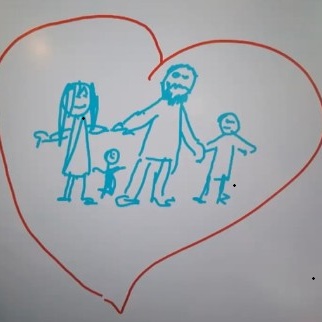
The pain of missing. Yeah. And before he named it himself. The pain of missing. Can. Can you draw me in some ways what is bothering you so much that is pulling and pushing so hard? So he draw that heart and putting his mom and his father and his dad in it, his little sister and himself, and he draw that lightning through that heart and together it was that we started to call it the pain of missing. Yeah. And once we have the pain of missing, we can also start to discover and try to unravel what links all with that pain of missing. Yeah. And in our exploration and trying to discover, we saw also.
And it are his drawings that showed that there was also a cloud, a cloud above his head. And not just a cloud, but a really dark cloud above his head.
And it was the dark cloud above his head that caused the nightmares.
Yeah. And it was a dark cloud above his head that caused the fear.
Yeah.
And the lightening. The pain of missing is always around the pain of missing.
When it is in his it's most heavily form.
It creates all kinds of firework. Exploding firework. Yeah.
So while we are developing those drawings and having conversations about what is good food for the pain of missing.
Like good food for the pain of missing is thinking of my mom and dad looking at the photos and pictures, hearing others talk about their mom and their dad seeing a television. Happy families.
And maybe the most influencing thing for the pain of missing was not being able to say goodbye to his mom and dad.
Yeah.
So I could also ask some questions about the impact and the effects.
Yeah. Like the dark cloud above his head that brings the nightmares, the sadness, the panic attacks and so on.
But at a certain point he. Although he also said, sometimes I even think that it's my fault that car crash.
I had to be nicer to my mom and dad. Yeah.
And he also showed me with some small puppets that dark cloud also makes or brings a big hab between him and his grandparents and even between him and his best friend. And he's chosen that hot wheel car for his best friend.
But when that big gap comes, it is also a cobra that is nearby.
And the fear of the cobra comes very close.
What I'm trying to do is finding language in his language so that we can unravel what is connected with all that pain of missing. Yeah. And at a certain point, I ask also, oh, and how did you try to respond to that pain of missing? How did you try to respond until now? Through the dark clouds.
And surprisingly, he came with a whole story about building a safe house in Minecraft as a response to the pain of missing.
And he said, and nobody gets in. In that safe house.
It protects me.
It's a place where I can hide for the pain.
It's a place where I no longer can be hurt.
And it also offers comfort, peace in my head, he was saying. So I had the honor to walk around together with him in his whole constructed safe house in the Minecraft game.
Yeah.
And walking around in that safe house and having a conversation about all those things that he is trying to do in that safe house, I could start to understand that, like also banging his head, Revolting. The medical interventions trying to keep everyone out of his room can be considered as responses to the crash, the car crash, the loss and the pain of missing.
So when we try to figure out where. Where is this all about that banging with your head. Revolting. The medical interventions trying to keep everything out of your room.
He started to tell that he wanted to be with his mom and his dad.
He doesn't want him to disappear out of his life.
He wanted him close to himself.
He is even afraid of forgetting them.
And especially he's afraid to lose the smell of his mom.
So we started to conclude through our conversations and discoveries that maybe also it's a kind of battle against the injustices, a kind of battle against the unfairness of losing your parents, that pain of missing and that banging his head.
And at the same time, it's not a battle against the injustices, but it's also a fight for keeping them close, taking care of them.
Yeah. And once we collected all these stories.
Yeah.
We tried to share these stories with the important people around him.
So all the pictures that we had taken and the stories that were shared, we shared with grandparents, with grandmom, granddad.
And we sended also some drawings to his little sister.
And moreover, we send also a mail with the pictures to his best friend.
Yeah. And that opened up.
Yeah. That for the first time also his beloved ones could listen to all these stories and ways of comforting, doing safety, trying to protect his parents from disappearing. Yeah. And in that way, by listening to those stories and taking these stories very seriously, they became a real team of resilience. Because grandparents could start to share their ways of comforting.
And together they started to reflect on what could be helpful to him.
And in that doing together, they were also doing emotions together.
And a lovely idea that popped up was maybe we have to try to figure out how to make the banana cake of comfort. Yeah.
So grandma became specialist in reproducing the banana cake of mom.
And a funny thing was that we even got the cook of the hospital to his bedroom so that he could explain to the cook of the hospital how to make the most delicious banana cake of the world.
Yeah.
And another interesting opening that was created by sharing these stories from his language was that his best friend was proposing to help him to build his safe house even more safe so that it felt much more comfortable also.
And they decorated the house in all kind of crazy ways.
And each Tuesday evening, they were together on the Minecraft game.
Yeah.
In all this, what also was created that they found a new kind of relational dances and narratives together so that they could start to sense again how they could contribute to each other's lives.
What meant that there was felt again a sense of mattering each one to each other.
And in doing so, step by step, new perspectives, new alternative stories and new pathways opened up.
It meant in the same time that we were weaving networks of resilience in more and more widening circles.
Because what still was happening was that now and then Victor was asking himself, am I the only person on this planet who has to go along with that pain of missing? Because that pain of missing had changed already from weight and form and wasn't that big lightening any longer? But some questions were still keep on keeping on puzzling him. Yeah.
Do other children recognize the pain of missing?
Does pain of missing also bring dark clouds and lightnings to other children?
How do you try to comfort yourself?
And all those questions that we gathered that were still puzzling his mind.
Yeah. We put in a questionnaire, and that questionnaire was sent to experts by experiences other children and youngsters who lost a parent, who lost or who lost both their parents, and they wrote wonderful responses to him.
And that made that we could really weave networks of resilience in more and more widening circles.
It became also a movement from isolation and alienation to a sense of belonging, because being noticed and taken seriously by the significant people and community and sharing together the concerns and obstacles. But above all, the efforts and commitments opens up a lot of new possibilities.
While we took all those steps with Victor, with grandparents, with his little sister, with his friend, with the community and connecting him again with the community, we were laying down a path in walking.
And that made also that a sense of continuity and coherence got facilitated, got enhanced in some ways.
So during the process, we collected masses of puzzle pieces, a multitude of stories. And each piece of story that we collected, each important person that popped up, we put into a bead and we were really making a string of beads.
It was constantly weaving new threads into the larger fabric of life. And through that, documenting stories became shareable and support could be provided.
And maybe one last thing I still want to say is that that whole journey that I was describing and taking you on to was that that journey isn't or wasn't a highway to heaven. In a sense, that that doesn't meant that everything was solved, that there were no longer difficulties. Yeah, because I think change comes rather over time than overnight.
The toughness of the problems and meaning, each new experience or interaction, each new life phase can reshuffle the hard one. Perspectives, meaning and sense of coherence.
Yeah. So that means that when Victor becomes older, each time again, there will pop up a little bit of pain of missing. Yeah. But he will have to find each time again a new position in relation to that pain of missing.
But what is the most important is that they had found some more ways and new ways to go on with their lives and without losing each other.
I hope that the story of Victor and the different steps that I take, that they give you some ideas, some inspiration to go along and go on journeys of rediscovering with children, families with painful histories or traumatic experiences.
Thank you very much.
[00:41:59] Speaker B: Thank you for listening to this podcast from International Journal of Narrative Therapy and Community Work published by Dulwich Centre Foundation. More about this recording and a treasure trove of articles, videos and multimedia works are available from narrativetherapyjournal.org it's all free to access and share with no login required.
Dulwich Centre is located on the land of the Kaurna people. We acknowledge the traditional owners of country and pay respect to elders past and present.